Thursday, 13 March 2014

President Jonathan Approves Forensic Audit Of NNPC!


Nigeria’s President Goodluck Jonathan has authorized a forensic audit of the NNPC, the state energy company, the presidency said on Wednesday, after weeks of public uproar over an alleged $20 billion in missing state revenues.
Central Bank Governor Lamido Sanusi wrote a letter last September to President Goodluck Jonathan saying almost $50 billion in revenues from oil exports from January 2012 to July 2013 had not been remitted to the federation account, in a clear violation of the law.
He lowered the estimate to $20 billion in testimony to a Senate committee investigating the case last month, days before he was suspended by Jonathan for what the president said was unrelated “financial recklessness” and “gross misconduct” at the central bank. Government sources and a wide spectrum of the public believe his removal was politically motivated.
The Nigeria National Petroleum Corporation (NNPC) has repeatedly denied Sanusi’s allegations and the presidency, which says they are unfounded, has not responded until now to calls for an independent audit.
Nigeria has a reputation for corruption but the scale of the alleged oil graft is unprecedented and Sanusi is the most high-profile figure to raise issues directly to the president.
Sanusi was an internationally respected central bank governor and financial markets were rattled by his suspension with the naira currency briefly dropping to a record low.
Nigeria’s Finance Minister Ngozi Okonjo-Iweala and a Senate committee investigating the graft allegations have both called for a forensic audit of NNPC since Sanusi presented evidence.
Jonathan’s opponents say the suspension of Sanusi shows he is soft on corruption, a year ahead of what is expected to be the most closely fought presidential election since Nigeria ended military rule in 1998.

UNPROVEN CLAIM
The Presidency wishes to reaffirm that Mallam Sanusi’s suspension has absolutely nothing to do with his unproven and inconsistent claim,” Reuben Abati, Jonathan’s spokesman said, referring to Sanusi by the title Mallam, given to learned Muslims.
Mallam Sanusi’s allegations are patently untrue. But Government is making no effort to bury them as he falsely claims,” Abati’s statement said, adding that “reputable international firms” would carry out the audit.
Abati did not indicate which foreign firms will handle the audit.
According to Sanusi’s testimony, the biggest gap in accounting is for $8.5 billion the NNPC says it retained from revenues during the 19-month period to cover subsidies it was owed on importing gasoline and kerosene.
A directive in 2009 by then President Umaru Yar’Adua, who died in May 2010, had scrapped kerosene subsidies. Petroleum Minister and NNPC chair Diezani Alison-Madueke acknowledged this but told the senate committee they were still paid, contrary to the law, to prevent hardship for millions of poor Nigerians.
NNPC says it buys kerosene at 150 naira ($0.91) a liter and sells it to suppliers at 50 naira per liter. But the retail rate is still above 150 naira, which Sanusi said proves the subsidy is a racket to benefit chosen friends in the kerosene business.
It is fine to have a forensic audit but I think it is merely a way to keep us satisfied for a little while,” Senator Bukola Saraki, who is sitting on the investigating committee, told Reuters this week.


Wednesday, 12 March 2014

13 bodies recovered from boat mishap in Festac Town!


Mr Ibrahim Farinloye, Information Officer, National Emergency Management Agency (NEMA), on Wednesday confirmed that 13 dead bodies had been recovered from the boat accident in Lagos on Tuesday.

Farinloye told the News Agency of Nigeria that the boat capsized at 4th Ave, opposite 41 Road Junction in FESTAC Town, Lagos.
Scene of the incident
He said the accident occurred while the boat was trying to cross the passengers from one side of the road to the other over a distance of about 10 metres.
Farinloye said the boat had over 15 passengers and confirmed that among the dead were two children, while five persons were still missing.
The NEMA official said that there were six survivors.
He added that a distress call came to the agency at 11.10 p.m. on Tuesday and said that rescue operation led to the recovery of the bodies.
Farinloye said that NEMA in collaboration with other emergency service agencies was continuing with the rescue operation.
Also Dr Femi Oke-Osanyintolu, General Manager, Lagos State Emergency Management Agency (LASEMA), confirmed that 13 dead bodies had been recovered from the mishap.
Oke-Osanyintolu told NAN on Wednesday that the surviving victims had been taken to hospital for treatment.
Thirteen persons have been confirmed dead and their bodies recovered, while six of the victims have been taken to the Lagos State University Teaching Hospital (LASUTH) for treatment,’’ he said
source: News Agency of Nigeria

Respond To Charges Against You And Stop Misinforming The Public- Presidency Tells Sanusi!


The Presidency has charged the suspended Governor of the Central Bank, Mallam Sanusi Lamido Sanusi to respond to charges laid against him, rather than cast aspersion on government.
The Presidency also reaffirmed that his suspension had nothing to do with his claim that $20billion is missing from the national treasury.
Briefing journalists at the Presidential Villa Abuja, Presidential Media Aide, Rueben Abati reading from a statement made available to journalists said ordinarily the Presidency would not join issues with Sanusi, but seeing he is still a Presidential appointee and the manner in which he has been misinforming the public made it imperative.
The Full statement Reads: "We have noted with disappointment, the unrelenting attempt by the Governor of the Central Bank of Nigeria, Sanusi Lamido Sanusi to falsely portray his recent suspension from office as an attempt by the Presidency to bury his allegation that huge sums of money due to the Federation Account are unaccounted for by the Nigerian National Petroleum Corporation (NNPC).
"The Presidency wishes to reaffirm that Mallam Sanusi’s suspension has absolutely nothing to do with his unproven and inconsistent claim that $49.8 Billion, $12 Billion or $20 Billion is missing from the national treasury.
"As was clearly stated in the letter suspending him from office and confirmed by President Goodluck Jonathan in his last Presidential Media Chat, Mallam Sanusi’s suspension was wholly based on the need for him to step aside while the weighty charges of financial recklessness, gross misconduct and persistent disregard for laid down rules and regulations in the management of the Central Bank made against him by the Financial Reporting Council of Nigeria and others are properly investigated.
"It is most unfortunate that instead of trying to provide some reasonable response to the clear and unambiguous query of his official conduct as Governor of the Central Bank, Mallam Sanusi  has cynically chosen to whip up public sympathy for himself and anger against the Federal Government by deliberately misleading unwary Nigerians and the international community into believing the falsehood that he is being punished for exposing corruption.
"In recent days, the suspended CBN Governor has, following in the footsteps of others who have an axe to grind with the government, taken to spreading his false claims and allegations through gullible foreign media correspondents, telling them among other things that his threat to force commercial banks to open up their books to unravel the whereabouts of the “missing” funds whether $49.8 Billion, $12 Billion or $20 Billion, ultimately led to his suspension.
"He also continues to make the mischievous claim that the government is somehow involved in a scam to divert huge sums of money from the Federation Account through the misappropriation of kerosene subsidy funds.
"Mallam Sanusi’s allegations are patently untrue. But Government is making no effort to bury them as he falsely claims. Relevant committees of the National Assembly are still investigating the claims and the suspended CBN Governor remains free to give evidence before them in support of his allegations.
"Furthermore, in keeping with its avowed commitment to full transparency, openness and accountability in governmental affairs, the Federal Government has authorized the engagement of reputable international firms for the recommended forensic audit of NNPC accounts.
"The Presidency condemns Mallam Sanusi’s resort to playing politics with serious national issues.  His suggestion that the phantom missing funds may have been diverted to fund campaigns for next year’s general elections is mischievous, irresponsible and designed to incite other political parties and members of the public against the Federal Government.
"The claim which amounts to cheap blackmail against the government and was clearly made in furtherance of a selfish personal agenda is most unbecoming of someone who still holds the High Office of Governor of the Central Bank of Nigeria.
"The Presidency would not ordinarily have wished to join issues with Mallam Sanusi who as CBN Governor remains an appointee of the President, but the very unacceptable manner in which Sanusi has been misinforming the public made it imperative that this statement be issued".

Money stolen from Nigerian Treasury is shared by a cabal, Sanusi tells New York Times!


After his unceremonious removal from the Central Bank of Nigeria late February, Sanusi Lamido Sanusi still insists that a huge amount of money is missing from the Federal Government coffers and the Goodluck Jonathan Administration owes the country a responsibility to get to the root of the alleged misappropriation.
This New York Times piece examines Sanusi’s call for investigation and allegations of recklessness, incompetence, abuse of mandate and criminal acts of negligence leveled against the Kano prince.
The piece below:
Even in a country where untold oil wealth disappears into the pockets of the elite, the oil corruption scheme he was investigating seemed outsize — and he threatened to lay it bare at a meeting with Nigeria’s top bankers. 
The rabble-rouser was none other than the governor of the country’s central bank. Weeks later, however, he was out, fired by Nigeria’s president in an episode that has shaken the Nigerian economy, filled newspapers and airwaves here, and even inspired a rare street demonstration. 
The bankers were going to have to open their books, the governor, Lamido Sanusi, warned them at the recent meeting. He wanted to see where the money was going — $20 billion from oil sales that, mysteriously, was not making its way to the treasury, in a country that could soon be declared Africa’s biggest economy and already attracts the most direct foreign investment on the continent, according to the United Nations.  
But his suspicions were cutting too close, Mr. Sanusi said — too close to an oil-politics nexus that both feeds the political establishment in Nigeria, in his view and that of analysts, and deprives the country of vital revenue. 
The charge of missing oil money is not new in Nigeria. In recent years, government commissions, parliamentary inquiries and civil society groups have all pointed to serious shortfalls in the disbursement of oil revenues. Their findings have been ignored. 
This time, the accusations appear not to be going away: Never before has an official at Mr. Sanusi’s level made them.
In interviews here, Mr. Sanusi gave a detailed account of the events that he said led to his ouster on Feb. 20, a dismissal that continues to depress the country’s currency and frighten investors. He said his warning to the bankers had been reported straight back to the threatened seat of power in the country’s capital, Abuja.
It was too much, he said. With his accusations, which outside analysts consider credible, the soft-spoken, bow-tied central banker appeared to have penetrated to the heart of the country’s entrenched corruption problem.
In 2009, Mr. Sanusi took aim at Nigeria’s failing banking sector, shutting down fraudulent banks, uncovering theft that led to an unprecedented conviction, and earning trust in international financial markets. He was named central bank governor of the year by The Banker magazine in 2011, and is a suited-up member of his country’s establishment, as an heir to the position of emir in the ancient northern city of Kano, one of Nigeria’s highest-status designations.
But then he began taking on the government oil agency, which determines whether oil-dependent Nigeria rises or falls. Specifically, he accused the Nigerian National Petroleum Corporation — the agency that buys, sells, regulates and produces the country’s oil — of not turning over earnings to the country’s central bank. The country is Africa’s largest oil exporter, oil prices were steady or rising, yet Nigeria’s financial reserves were falling. It was a mystery. The money was missing. Mr. Sanusi said he feared an eventual collapse of Nigeria’s currency.
Backed by calculations, he presented his findings to a Nigerian Senate committee early in February. “A substantial amount of money has gone,” 
Mr. Sanusi said in an interview at the mansion reserved for the country’s central banker, which he will soon have to leave. “I wasn’t just talking about numbers. I showed it was a scam.”
At a time when political energy in Africa’s most populous country is focused on next year’s elections — and staying in power is costly for a governing party that functions as a patronage machine — Mr. Sanusi knew exactly which interests he had menaced, he said. He had been warned to “cool down.
By making N.N.P.C. an issue now, the source of money for financing elections is threatened,” Mr. Sanusi said, referring to the petroleum corporation. “If this is stopped, there will be no money to finance the elections.”
On the other hand, if it was not stopped, the risk to Nigeria’s economy was grave, the central banker suggested. “It was critical that we stop this hemorrhage,” he said. “Otherwise, we can’t maintain stability. Reserves had gone way down. We would watch the naira collapse,” he said of the nation’s currency.
Alarmed, Mr. Sanusi said, he went in front of Nigeria’s top banking heads for a semimonthly meeting on Feb. 11 and “threatened to open the books of the bankers, to trace the money.” He suspected some were laundering stolen oil money.
Some of them were not giving information about their accounts,” the central banker said. “I told them I would order a special examination.”
One of the bankers at the meeting said, referring to the Central Bank of Nigeria, “He made it clear to them that the C.B.N. would need to unravel what was going on, and they should cooperate.”
Many of the bankers became angry. “One of us said, ‘What next?’ “ a second banker said. “There was a general heaviness. He spoke tough.” Both bankers requested anonymity.
Panicked, several of the bankers went straight to the government, Mr. Sanusi said. Two of the bankers — he would not identify them — “went and reported to the petroleum minister,” he said. And at that moment, his days were numbered.
The strategy of the government was to discredit the messenger,” he said. The Nigerian president “doesn’t want me to bring out any more information that would get them into trouble.”
Mr. Sanusi’s account is “untrue,” a spokesman for President Goodluck Jonathan said.
Mr. Sanusi has been making all kinds of claims to project himself as a victim,” the spokesman, Reuben Abati, said in an email, accusing the former bank governor of “financial recklessness, abuse of mandate, incompetence and criminal acts of negligence.
Mr. Sanusi has not been charged with any crimes, and the most Mr. Jonathan held him responsible for in a series of counteraccusations that emerged after the bank governor raised an alarm over the oil money was having perhaps “sidestepped civil-service rules.”
Outside analysts appear to be in large agreement that Mr. Sanusi’s claim of vast missing oil revenues is plausible.
Nigeria’s state oil sales “feature undue complexity, extensive discretion and well-documented flaws,” Revenue Watch, a group focused on natural-resource management, wrote in an examination of the central banker’s declarations. “In such a system, the line between mismanagement and corruption is difficult to draw, as shortcomings in process often benefit specific private interests.”
One such “shortcoming” was laid bare by Mr. Sanusi last month to the parliamentary committee: a phony subsidy on kerosene that he determined to be a racket, costing the Nigerian treasury billions of dollars and greatly benefiting what he called a “syndicate” of marketers and unknown others. Mr. Sanusi showed that any official subsidy on kerosene had long since been abolished, that the petroleum corporation was nonetheless selling kerosene to marketers at less than a third of its purchase price on the international market and that the Nigerian marketers were then selling kerosene to the public at prices 300 to 500 percent above what they had paid for it.
It’s just a big scam,” Mr. Sanusi said in the interview. “The amount is shared by a cabal.”
Though his official term would have ended in June anyway, Mr. Sanusi said, he is challenging his removal in court. In a judiciary that is only lightly insulated from political pressure, the outcome is uncertain, though perhaps not with the wider public. One of the bankers at the Feb. 11 meeting said: “For me personally, I don’t think there’s anything wrong with the position he has taken. We are Nigerians. We owe it to this country that things are run properly.”
One of Nigeria’s leading activists, Tunde Bakare, a founder of the pro-democracy organization Save Nigeria Group, said: “This is going to be tried in the court of public opinion. We can’t wish this matter away. Twenty billion dollars is not going to go away overnight.”

Tuesday, 11 March 2014

Wounded Terrorists Captured, Make Confessions And Plead For Mercy!


Scores of wounded terrorists who escaped from various camps under the fire of security forces have been captured in the fringes of Lake Chad, the Defence Headquarters said.


A statement issued by its spokesperson, Major General Chris Olukolade in Abuja on Tuesday, said that the captured terrorists some of whom are fatally wounded are already making useful statements to interrogators of the Multi-National Joint Task Force.
He said that others  were captured by troops in locations around Dikwa, Cross Kauwa, Kukawa and Alargarmo.

He said, "In their confessions, it was revealed that some of the camps have been disbanded following the directive of their clerics who declared that the operation of the sect had come to an end as the mission could no longer be sustained. The terrorists who are giving useful information as to the locations of their remnant forces, are full of apologies and pleas for their lives to be spared promising to cooperate.

"They confirmed that starvation was a major problem in addition to ceaseless bombardments on the camp locations even when they kept relocating. They also confirm that several members of the group have been wounded and no treatment was forth coming. Troops have continued their assault on other locations across the states covered by the state of emergency."


The defence headquarters spokesperson added that members of the public who have started visiting to engage in sight seeing in some dislodged camps and fringes of  forests such as Sambisa and others have been warned to desist from doing so as the tendency will no more be condoned where operations are still ongoing. The general area still remains a theatre and movement remains restricted as the environment has to be cleared for safety of citizens.    The public will be informed when the locations are safe enough

Angelina Jolie stars alongside her youngest daughter in new film role!


Inside Disney's Maleficent
Jolie and daughter in the film
Looks like the acting finesse is spreading to the next generation as Hollywood A list Actress Angelina Jolie acted alongside her youngest daughter in a soon to be premiered movie titled Maleficent

Some photos from the film below:


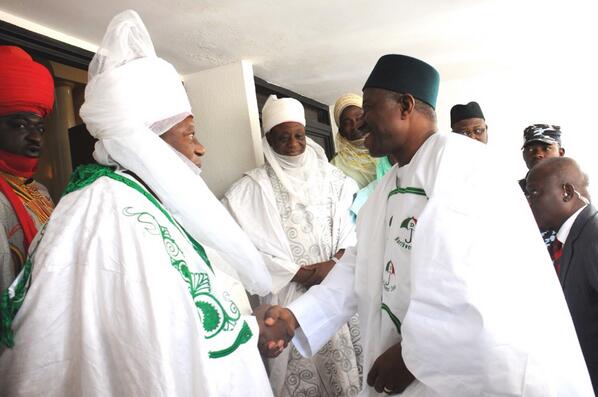
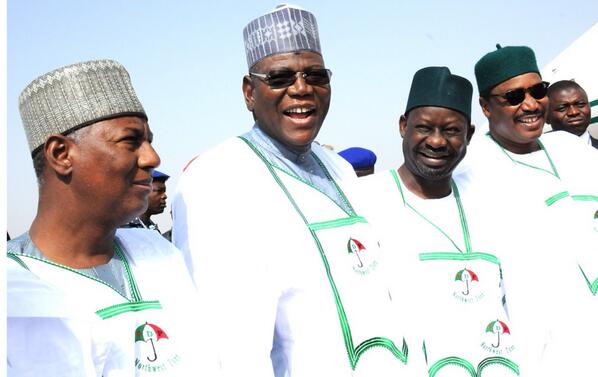
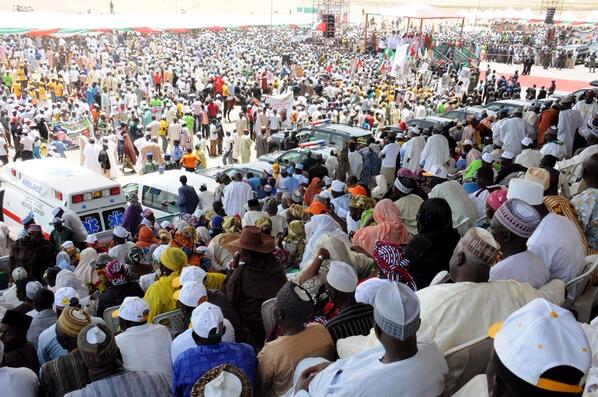
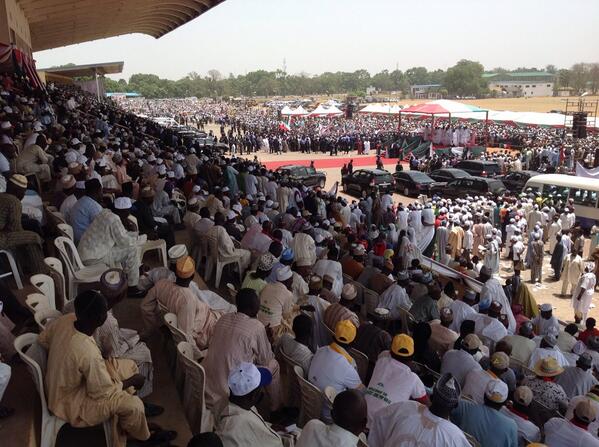
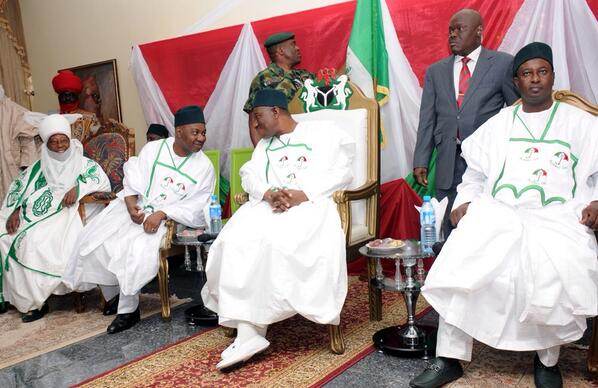
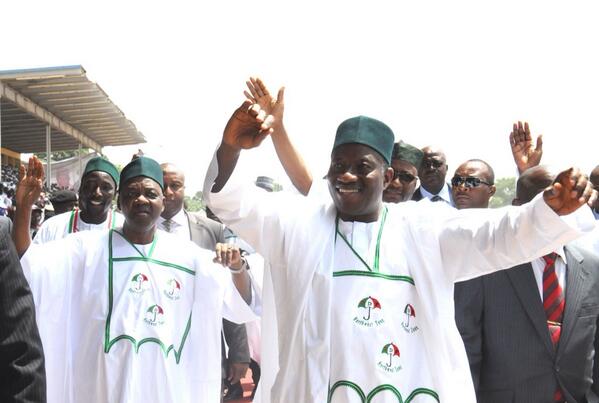
2015 elections in perspective - President Jonathan's PDP North West Zonal Rally in Kaduna today!


President Jonathan was in Kaduna today for PDP North West Zonal Rally,

Photos below:

Embedded image permalink

Embedded image permalink

Embedded image permalink

Embedded image permalink